Hospitality has moved beyond AI experiments: what hotels are doing next
From payment flexibility and booking protection to weather guarantees and immersive content, learn how Aven's growing partner ecosystem helps hotels create better booking experiences and convert more direct bookings.
See how hotel chains are moving beyond AI experiments to improve efficiency, personalize booking journeys and deliver measurable value, based on h2c’s AI Opportunity Study 2026.
Published October 9, 2026 • 6 minute read

For the past few years, the hospitality industry has debated whether AI could improve guest service, increase efficiency and unlock new revenue opportunities.
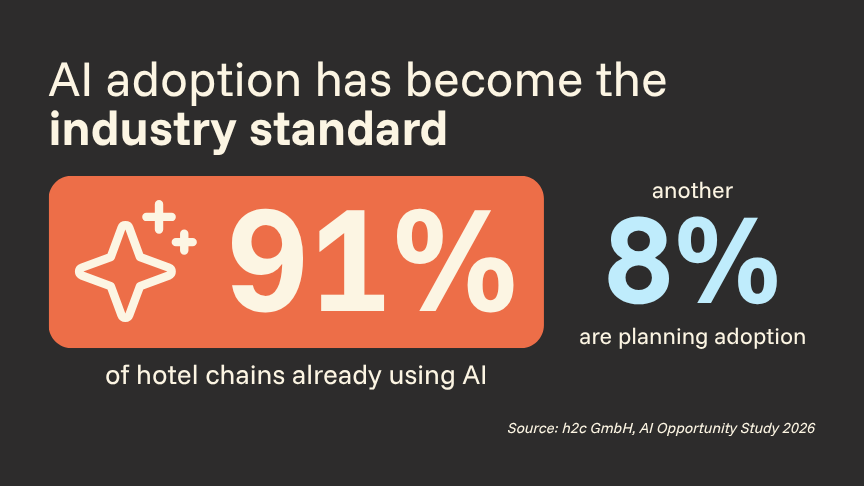
According to h2c GmbH’s AI Opportunity Study 2026, of which Aven Hospitality is one of the sponsors, the industry has largely moved beyond those hypotheses. AI is now firmly embedded in hotel operations, with 91% of hotel chains already using AI and another 8% planning adoption within the next 12 to 24 months.
But the most interesting finding isn't how many hotels are using AI - it's how they're using it.
Drawing on 230 implemented AI use cases shared by 78 hotel chains, the study offers a practical view of where AI is delivering value today, and where hotels are focusing their investments next.
AI's impact is more practical than expected
Early discussions about AI often centred on dramatic, futuristic possibilities – but reality shows different.
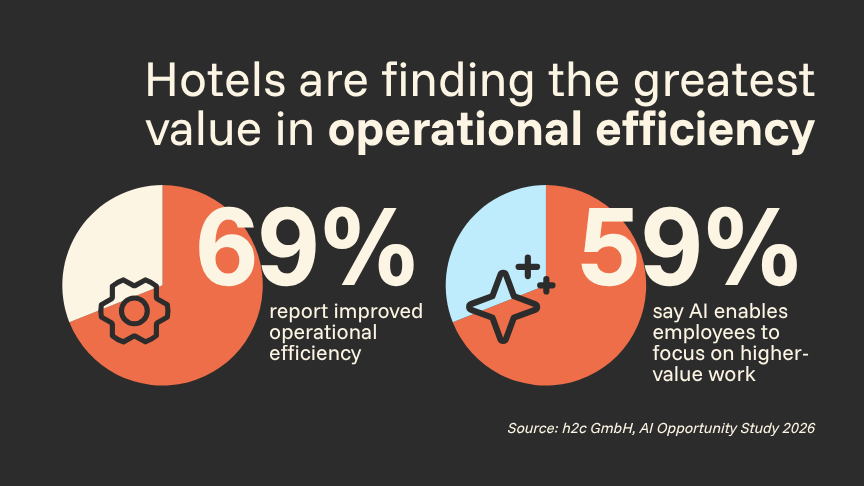
Nearly seven in ten hotel chains report using AI for improved operational efficiency and automation, while 59% say AI enables employees to spend more time on higher-value work. Improved guest experience was also identified as a key benefit by 32% of respondents.
Across the industry, AI is being used to support functions ranging from revenue management and forecasting to reputation management, guest communication, marketing, reservations, finance and technology automation.
These may not be the most innovative use cases, but they address real business challenges. Hotel teams are using AI to streamline workflows, accelerate decision-making and reduce manual effort - creating more capacity to focus on guests and business performance.
This uptake shows a healthy sign of AI maturity. Rather than implementing technology for hype, hotels are increasingly identifying specific operational and commercial challenges where AI can deliver measurable value.
The industry's focus is expanding beyond productivity
While operational efficiency remains the most established AI outcome, the next wave of investment is increasingly guest-facing.
The study found that approximately 84% of hotel chains are already using or planning conversational engagement capabilities such as chatbots, while 81% are investing in AI-enabled guest engagement and digital guest journeys. Three-quarters are investing in AI-powered personalization.
Hotels are no longer viewing AI solely as a back-office productivity tool. They are increasingly applying it to guest-facing experiences, recognizing that travelers expect faster responses, more relevant recommendations and smoother digital interactions throughout the journey.
Ying’nFlo, part of Langham Hospitality Group, shows how guest-facing AI can translate this shift into measurable results. Working with Aven Hospitality, the hotel introduced Concierge for Booking, an AI assistant known as ‘Sam’ that answers common questions using live data from the SynXis Central Reservations System and guides guests into the booking journey. The solution saved more than 31 hours of manual work per month, directed nearly one in four booking-related conversations into the booking journey and converted 8.3% of those referrals into confirmed bookings.
Beyond a conversational chatbot, the results show how well-integrated AI can turn better guest service into measurable operational and commercial value.
Personalization is emerging as a priority
Among the study's findings, personalization stands out as one of the strongest long-term opportunities.
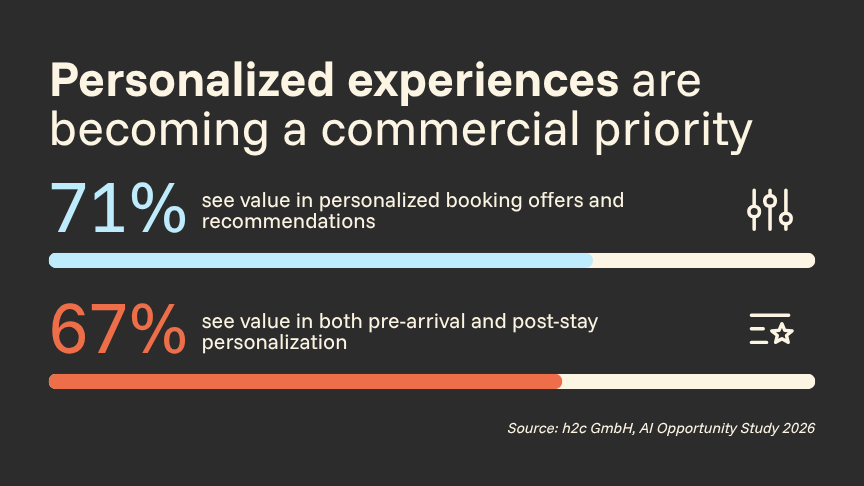
71% of respondents see value in personalized booking offers and recommendations, while 67% see value in pre-arrival personalization and 67% see value in post-stay retention offers.
Personalization is evolving beyond marketing campaigns and loyalty communications. Increasingly, it is becoming part of the commerce experience itself, influencing how hotels present offers, merchandise products and engage guests throughout the booking journey.
This trend aligns closely with the growing industry focus on retailing. Rather than offering every traveler the same experience, hotels are looking for ways to surface the most relevant rooms, amenities, upgrades and services based on context, preferences and intent.
Aven Hospitality applies this principle through Retailing, where AI and machine learning recommendation engine tailors ancillary offers to each customer’s profile and trip type within the Booking Engine. For example, Coco Collection used Retailing to present personalized, contextually relevant transfers, dining, wellness activities and other experiences based on each guest’s profile and trip type during booking, helping the Maldives resort group increase ancillary revenue by approximately 1.4 times year over year, sell 20% more ancillary offers and achieve a $300 average order value.
As AI matures, personalization will help hotels deliver more relevant experiences while driving upselling, cross-selling and conversion.
Building the foundation for AI at scale
Despite widespread adoption, most hotel chains acknowledge they are still in the early stages of their AI journey. Only 28% report having a company-wide AI strategy led by senior leadership. Respondents rated their internal AI knowledge at just 3.4 out of 10, and 56% identified lack of AI expertise, training or skills as the biggest barrier to adoption. Integration challenges, data governance issues and privacy concerns also remain significant obstacles.
More surprisingly, only 13% of respondents report measurable ROI from AI initiatives today.
This doesn’t suggest AI is failing as hotels have proved that AI can drive efficiencies and enhance guest engagement – what hotels need to do next is to scale those successes across its enterprise.
To do that, hotels need connected technology ecosystems, accessible and trusted data, integrated workflows and digital commerce platforms that enable AI to deliver value consistently across the business.
31% of hotel chains currently primarily rely on vendor-provided AI solutions, while a further 25% use a hybrid approach combining internal and external solutions.
Aven Hospitality enables this through the SynXis platform, which connects trusted hotel data, commerce workflows and more than 600 system integrations to help hotels deploy and scale AI across their operations and guest journeys.
With a connected foundation, hotels can move beyond isolated AI use cases and scale proven applications across the entire organization.
From experimentation to execution
One of the most positive responses throughout the research is how practical the industry's approach to AI has become.
Hotels are applying AI to improve efficiency, advance personalization and strengthen guest engagement. They are also exploring conversational experiences and AI agents, while focusing more on the applications that create measurable value for guests and hotel teams.
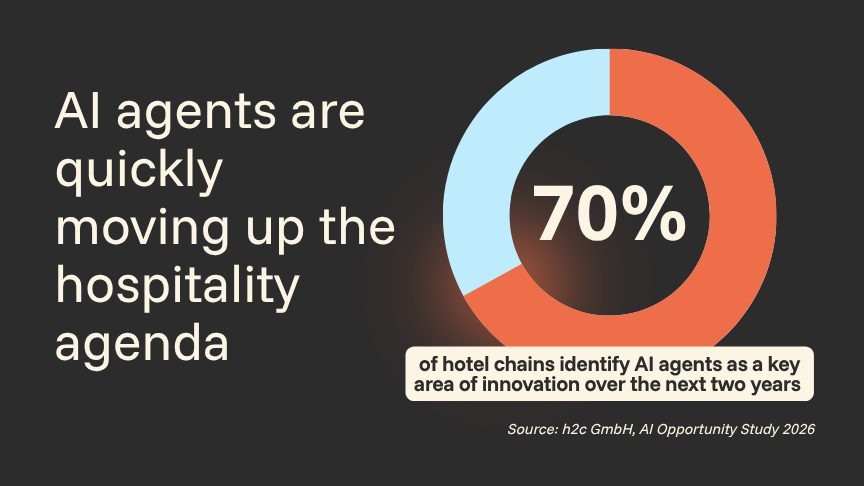
This shift is accelerating, with 70% of hotel chains identifying AI agents as an area of innovation in 2026, up from 48% in 2025.
As hotels explore these applications, they will need reliable ways for AI to interact with trusted hotel systems and data. Aven Hospitality is supporting this through its own Model Context Protocol (MCP) capabilities within the SynXis platform. Aven Hospitality MCP gives AI applications a standardized, governed way to access approved hotel data and capabilities, including content, rates, availability, policies and booking pathways.
The most successful organizations will not necessarily be those experimenting with the most AI tools. They will be the ones that successfully integrate AI into the experiences, workflows and commercial strategies that matter most.
Download the Hotel Chain Tech Report
Learn how 113 global hotel chains are approaching AI adoption. Download h2c’s Hotel Chain Tech Report for selected findings from the AI Opportunity Study 2026, including where hotel organizations are investing in AI and generating value.
About the author
Aven Hospitality is an independent global technology and SaaS leader in the hospitality industry, powering how hotels sell, distribute, and deliver guest experiences. SynXis, the leading global hospitality commerce and distribution platform, coordinates hotel information across 600+ integrations to ensure accuracy, consistency, and competitiveness wherever travelers discover, compare, and book.
Trusted by 35,000+ hotels across 190+ countries, Aven Hospitality serves as the connective layer behind many of the world’s most iconic brands, simplifying complexity behind the scenes so hoteliers can operate with confidence today and stay ready for what’s next.