Algorithms are selling your rooms, are you in control?
Why the future of hotel distribution will be decided in your core systems, not the AI interface.
Published March 17, 2026 • 5 minute read
Key takeaways:
- AI is reshaping hotel distribution by replacing traditional search with conversational discovery
- Core systems, not front-end tools, determine control in an AI-driven booking environment
- Structured and enriched data directly impacts hotel visibility in AI search
- Modern hotel distribution depends on data governance and consistency across systems
How AI is changing hotel distribution
There’s a quiet shift underway in hospitality. It doesn’t arrive with a new start-up logo or a louder metasearch auction. It arrives as a conversation.
Guests are beginning to plan trips by asking an AI assistant where to stay. They don’t browse ten tabs anymore. They describe what they want: “a calm boutique hotel in Bali with a yoga studio and fast Wi-Fi,” or “a family-friendly hotel in London near the Tube with connecting rooms.” And an algorithm decides what appears.
This is the new distribution frontier.
Every major technology company is moving closer to hotel inventory. New travel startups are building AI booking assistants. Traditional platforms are reinventing machine-to-machine commerce. The land grab isn’t noisy, but it is real.
And it raises an uncomfortable question for hotel leaders: When we connect to AI, what are we giving away?
The surprising answer: Win at the core
Many hotels assume the response to AI is to build new front-end tools: chatbots, copilots, voice booking assistants.
Those are useful. But they are not where control lives.
Control lives in the core.
In the systems that already define your business: your Central Reservation System, your PMS, your CRM, and, most importantly, the quality and governance of your data.
At Aven Hospitality, where you’re already working with large-scale reservation infrastructure across tens of thousands of properties, one lesson is clear: the winners in an AI world won’t be the loudest brands. They’ll be the ones whose core systems speak the clearest truth.
The CRS is no longer plumbing
For decades, the CRS was treated like pipes.
In an AI-driven world, it becomes your control tower.
Why? Because AI doesn’t invent hotel offers. It consumes structured data. Everything that defines your commercial strategy, rate fences, packages, loyalty rules, availability logic, and cancellation policies lives in your reservation infrastructure.
When AI asks for a room, it asks your CRS.
AI doesn’t simply rank hotels by price and availability. It uses your descriptive attributes, room types, amenities, experiences, and location context to interpret guest intent and determine relevance. This is how your brand is represented, matched, and ultimately chosen in an AI-driven journey.
If your CRS is governed and precise, the AI learns your business correctly. If it isn’t, the AI guesses. And guesses are dangerous.
Think of the CRS not as a backend system, but as your brand’s interpreter. It tells machines who you are, what you sell, and what you will never do.
The interface will change, from websites to voice assistants to autonomous agents, but the core will remain.
Structured data is table stakes: Enriched data wins
Hotels have structured ARI (availability, rates, inventory) data for decades. That alone is not enough. AI cares about context.
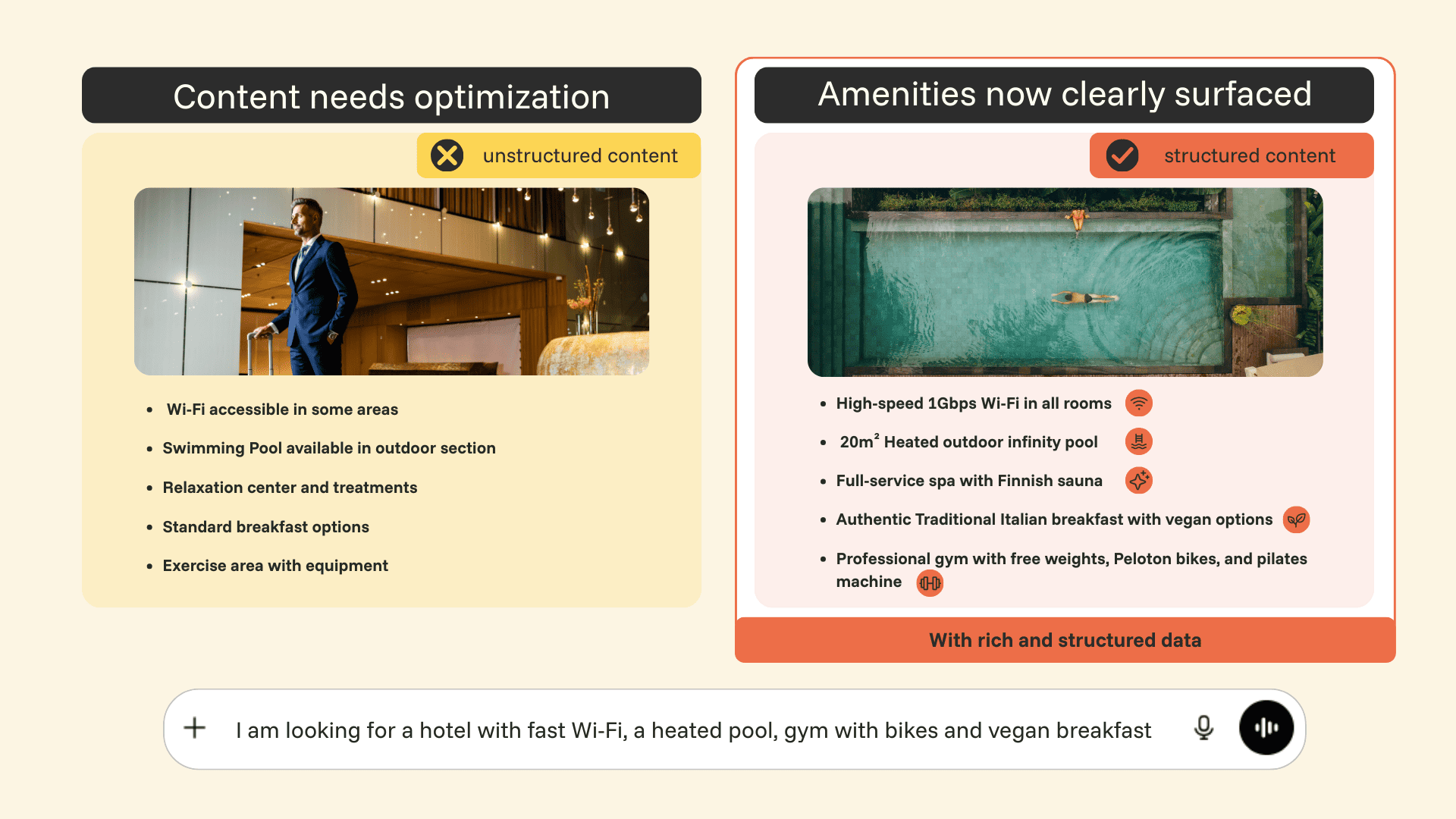
Guests don’t search for “Standard King Room.” They search for quiet, romantic, pet-friendly, walkable, wellness-focused rooms. If your systems cannot express those attributes clearly, your hotel disappears from the conversation.
Worse, inconsistent content becomes amplified.
If one system says you are pet-friendly and another doesn’t, the AI sees conflict. If your amenities are outdated in one channel, that version may be the one presented to a guest.
AI does not fix bad data. It amplifies it.
Leading hotels are beginning to treat content with the same rigor as pricing. Every description is tagged. Every amenity is verified. Every policy is consistent across systems.
Think of your data as modular building blocks:
- Room type
- Features
- Ideal guest
- Policies
- Value additions
When structured this way, an AI can accurately match your hotel to a guest’s needs. And suddenly your property shows up in conversations you were never visible in before.
That is not marketing. That is infrastructure.
Partnership without governance is exposure
Every AI platform will want direct access to your inventory. Some will promise reach, others will promise optimization. Many will promise both. Some partnerships will be valuable. Many will not.
Hotels have seen this movie before. Intermediaries expanded reach but reshaped distribution economics. AI could amplify that dynamic if hotels don’t define their own policies first.
The goal is not to resist AI. It is to integrate your terms.
The power of origin data
There is a difference between interpreting data and owning it.
Many companies will build layers on top of hotel content, AI wrappers, optimization engines, and aggregator feeds. They may add convenience. But they do not replace the original data. If your hotel feeds AI channels directly from a clean, governed source, your story is clearer. Your offers are accurate. Your brand voice survives.
If you rely on downstream feeds, your hotel becomes a generic entry in someone else’s model.
In an AI world, origin data is a competitive advantage.
Hotels that master it will see more precise recommendations, better conversion, and stronger direct relationships. Hotels that don’t may still be bookable, but increasingly invisible.
What hotel leaders should do now
You don't need a massive AI program to start. You need discipline. Five practical steps:
1. Treat content like ARI
Audit every description, amenity, policy, and image. Align them across systems. Remove inconsistencies. Update regularly.
2. Define your AI distribution policy
Decide what inventory and offers can be shared, and under what conditions. Encode those rules into your CRS and APIs.
3. Build modular data
Break hotel information into tagged attributes. Make your property legible to machines and meaningful to guests.
4. Choose partners carefully
Demand transparency. Understand how your hotel will be presented. Keep the ability to enforce your rules.
5. Invest in the backbone
Modernize reservation systems, APIs, and governance. AI-ready infrastructure matters more than flashy interfaces.
These are not glamorous projects, but they are the ones that determine whether AI becomes your best salesperson or your biggest leak.
A note on visibility
One of the biggest myths about AI is that it levels the playing field. It rewards clarity.
Hotels that cannot provide accurate, structured, up-to-date information will simply not appear when guests ask for recommendations. Visibility becomes a function of data quality, not an advertising budget.
This is already happening quietly. The properties that appear in AI recommendations are those whose systems speak clearly.
The future is agent-to-agent
Soon, a guest’s AI may negotiate directly with a hotel’s AI. It will ask for rooms, compare offers, check policies, and confirm bookings. This future isn’t science fiction. It is emerging now.
And in that world, your CRS becomes your negotiator. Your data becomes your brand voice. Your governance becomes your revenue manager.
If the core is strong, AI amplifies you. If the core is weak, AI could replace you.
Control lives in the core
Hospitality has always been about experience. AI will not change that. But it will change how guests discover experiences. The hotels that thrive will not be those chasing every new interface. They will be those who understand that their control lives in infrastructure.
Your systems. Your data. Your rules.
Invest there, and every AI channel becomes an extension of your strategy. Ignore it, and your strategy becomes whatever the algorithm decides.
This moment is not about resisting technology. It is about remembering what matters.
Win at the core, and your data becomes your competitive edge.
Who are you?
-
I am an existing Aven customer
-
I am interested in the Aven platform