Why traditional marketing agencies aren't enough for hotels
As hotel demand becomes increasingly fragmented, discover why industry expertise matters when reaching travelers across the channels that shape discovery, booking, and long-term revenue growth.
Published November 2, 2026 • 7 minute read
Today hotels have more opportunities than ever to connect with travelers, but the marketing landscape has also become increasingly complex and crowded. Demand is fragmented across direct channels, online travel agencies, travel advisors, corporate travel programs, metasearch platforms, and emerging touchpoints such as AI.
Talker Research commissioned by Aven Hospitality found that traveler paths to purchase are increasingly varied: 49.5% of travelers most often book through hotel-owned digital channels, compared with 32.7% through OTAs – proving competition for travelers’ attention is intensifying, while commercial teams face growing pressure to maximize the return on every marketing dollar.
Because of this, many hotels rely on traditional agencies for paid search, display, social media, SEO, and media planning. While these agencies bring digital expertise, they often lack deep specialization in the hotel industry. By contrast, technology partners understand how marketing connects with distribution and revenue performance.
Read on to learn how Aven Hospitality combines in-house expertise with a deep understanding of the hotel industry to deliver measurable results, illustrated through real-world case studies.
Hotel marketing is more than campaign execution
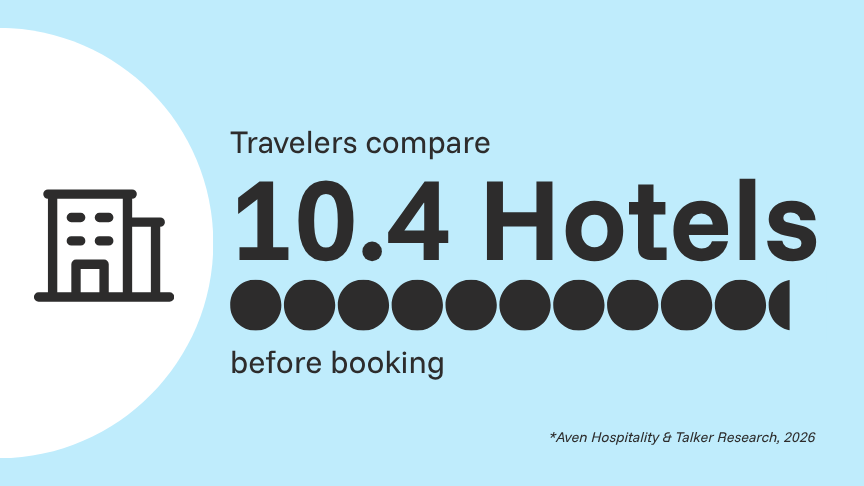
A traveler may discover a property through Google search, but that is only one part of the equation. Today’s travelers consider an average of 10.4 hotel options before making a reservation, reinforcing the need for hotels to remain visible and persuasive throughout an increasingly complex decision journey.
Hotels must also reach the travel advisors and corporate buyers who influence where their clients stay. As a result, hotel marketers have to look beyond media selection and campaign optimization. They must consider how to balance investment between direct and indirect channels, where to focus demand generation efforts, and how to influence the audiences most likely to deliver long-term revenue growth.
Rather than viewing marketing solely through the lens of digital performance metrics, hospitality-focused partners such as Aven Hospitality bring a deeper understanding of how travelers book and how distribution supports a hotel’s commercial objectives. The goal is not just to execute campaigns but also to help hotels determine where and how to invest for the greatest business impact.
Extending direct demand through hospitality-focused digital marketing
Growing direct bookings remains a priority for many hotels, but increasing advertising spend alone is not enough. Effective demand generation starts with understanding how travelers move from research to booking and reaching them at the moments that matter.
Tailored specifically for hotels, Aven Hospitality’s Digital Marketing service combines industry expertise with full-funnel advertising to drive direct demand. Paid search, metasearch, social advertising, display, and performance-based media are strategically deployed to improve visibility and attract travelers who are more likely to convert.
For Seibu Prince Hotels & Resorts, this meant concentrating investment on the channels and audiences most likely to generate incremental revenue. In partnership with Aven Hospitality, the hotel group achieved a 10:1 return on ad spend, increased ROI by 33%, grew incremental revenue by 1.5 times, and improved click-through rate performance 2.4-fold. The results demonstrate how a more deliberate digital strategy can translate into stronger direct demand.
How Google’s latest advertising capabilities benefit hotels
One of the challenges facing hotels today is keeping pace with the rapid evolution of travel search and digital advertising. New campaign formats, AI-driven advertising capabilities, and traveler discovery experiences continue to reshape how guests find and book accommodation.
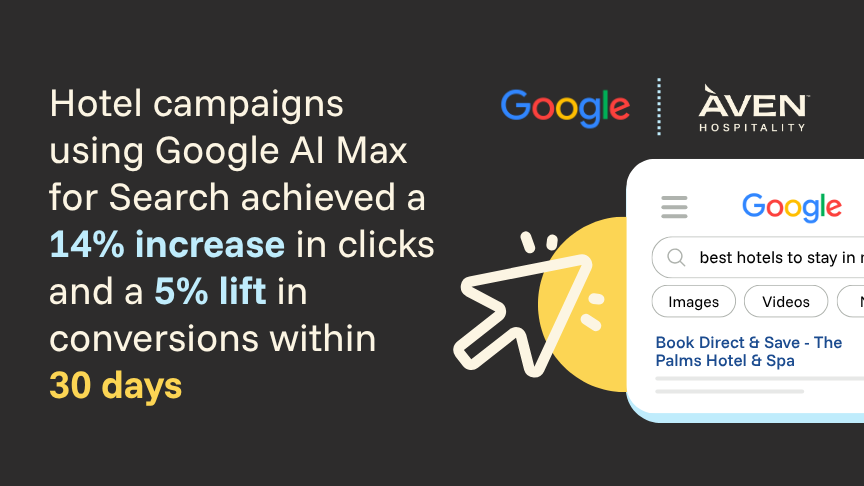
Aven Hospitality maintains a longstanding relationship with Google, providing our team with dedicated account support, priority global services, exclusive training, and access to travel industry insights. Aven is also frequently among the first organizations to test emerging Google advertising capabilities. In a recent rollout of Google AI Max across high-volume search campaigns, this early access helped hotel customers increase clicks by 14%, conversions by 5%, and conversion value by 8% within 30 days.
For hotels, the advantage is earlier access to emerging capabilities, backed by Aven Hospitality’s close collaboration with one of the industry’s most influential technology partners. This helps customers anticipate shifts in traveler search behavior and adapt their strategies as the market evolves.
Driving visibility where travel advisors make booking decisions
Direct bookings may dominate hotel marketing priorities, but they are only part of the demand mix. Travel advisors also remain influential during discovery, with 17% of travelers turning to them for hotel recommendations. For hotels, visibility within advisor workflows is therefore an important part of a broader commercial strategy.
Many hotels participate in the Global Distribution System, but participation alone does not guarantee visibility. In competitive destinations, hotels must actively differentiate themselves if they want to capture the attention of travel advisors evaluating multiple accommodation options on behalf of clients.
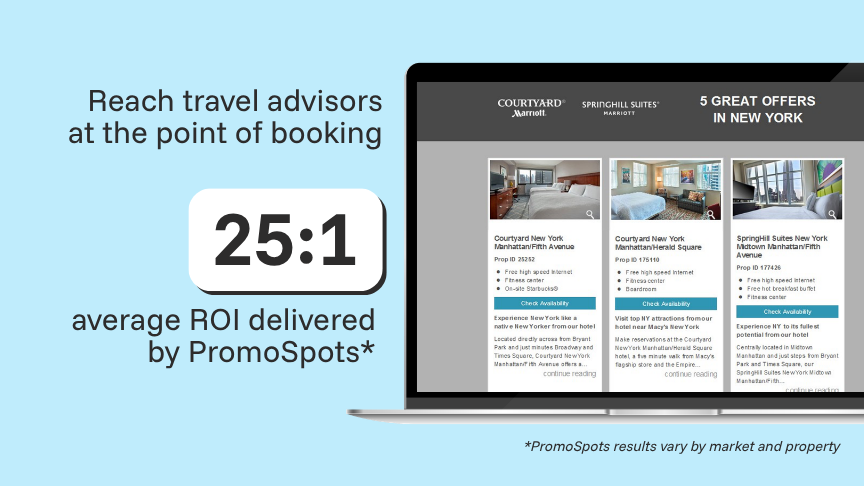
Aven Hospitality's GDS Marketing service helps hotels achieve this through solutions including Sponsored Property placements, PromoSpots, sign-in messaging, banner advertising, and targeted promotional campaigns. These programs position hotel brands in front of travel advisors at critical moments during the booking process, helping properties stand out when purchasing decisions are being made.
The scale and effectiveness of these programs is substantial. GDS Marketing generated more than six billion impressions among travel advisors and achieved average PromoSpots returns of approximately 25:1, depending on market conditions and property characteristics. For hotels seeking to influence higher-value travelers and drive additional indirect demand, marketing within the channels used by travel advisors represents a significant opportunity that traditional agencies rarely address.
Unlocking corporate travel demand through Consortia Services
Corporate travel remains one of the most valuable and resilient demand segments for many hotels, with 90% of corporate bookings now made through online booking tools. However, gaining access to this business often requires participation in consortia and Travel Management Company (TMC) programs that can be complex and resource-intensive to manage independently.
Because these programs sit at the intersection of marketing, sales, and distribution, they frequently fall outside the remit of traditional marketing agencies. Yet they represent an important source of room nights, particularly for hotels seeking to diversify demand and increase exposure to corporate travel buyers.
Aven Hospitality's Consortia Services help hotels navigate this landscape by providing access to leading consortia and TMC programs while reducing the operational complexity associated with participation. Beyond program access, the service helps hotels strengthen their visibility among travel buyers and advisor networks that influence managed travel decisions.
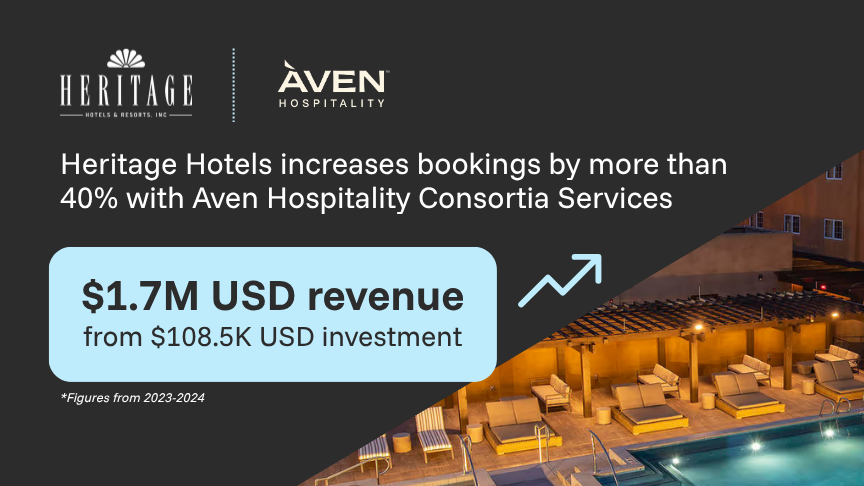
The business impact can be significant. After working with Aven's Consortia Services team, Heritage Hotels achieved a more than 40% increase in bookings, acquired new corporate accounts, improved profit per booking, and generated approximately $1.7 million in return from an investment of roughly $100,000. These results illustrate the value of approaching corporate travel demand as a strategic growth opportunity rather than simply a distribution exercise.
Looking beyond campaigns to commercial growth
The distinction between a traditional marketing agency and a hospitality marketing partner ultimately comes down to perspective. Agencies focus on campaigns. Hospitality specialists focus on demand.
Hotels must influence travelers wherever booking decisions occur, whether through direct digital channels, travel advisor networks, or corporate travel programs. Success depends on understanding how these channels work together and how marketing investments can support broader commercial objectives.
This is why hospitality-focused marketing services continue to gain importance. Aven Hospitality’s Digital Marketing, GDS Marketing, and Consortia Services each address a different source of demand, but together they help hotels build a more balanced, resilient, and profitable commercial strategy.
In a marketplace where competition for travelers is growing and distribution complexity continues to increase, hotel marketers need more than campaign execution. They need partners who understand the unique dynamics of hospitality and can translate marketing investment into measurable business outcomes.
Connect with the Aven Hospitality team to learn how a tailored digital marketing strategy can support your business needs.